
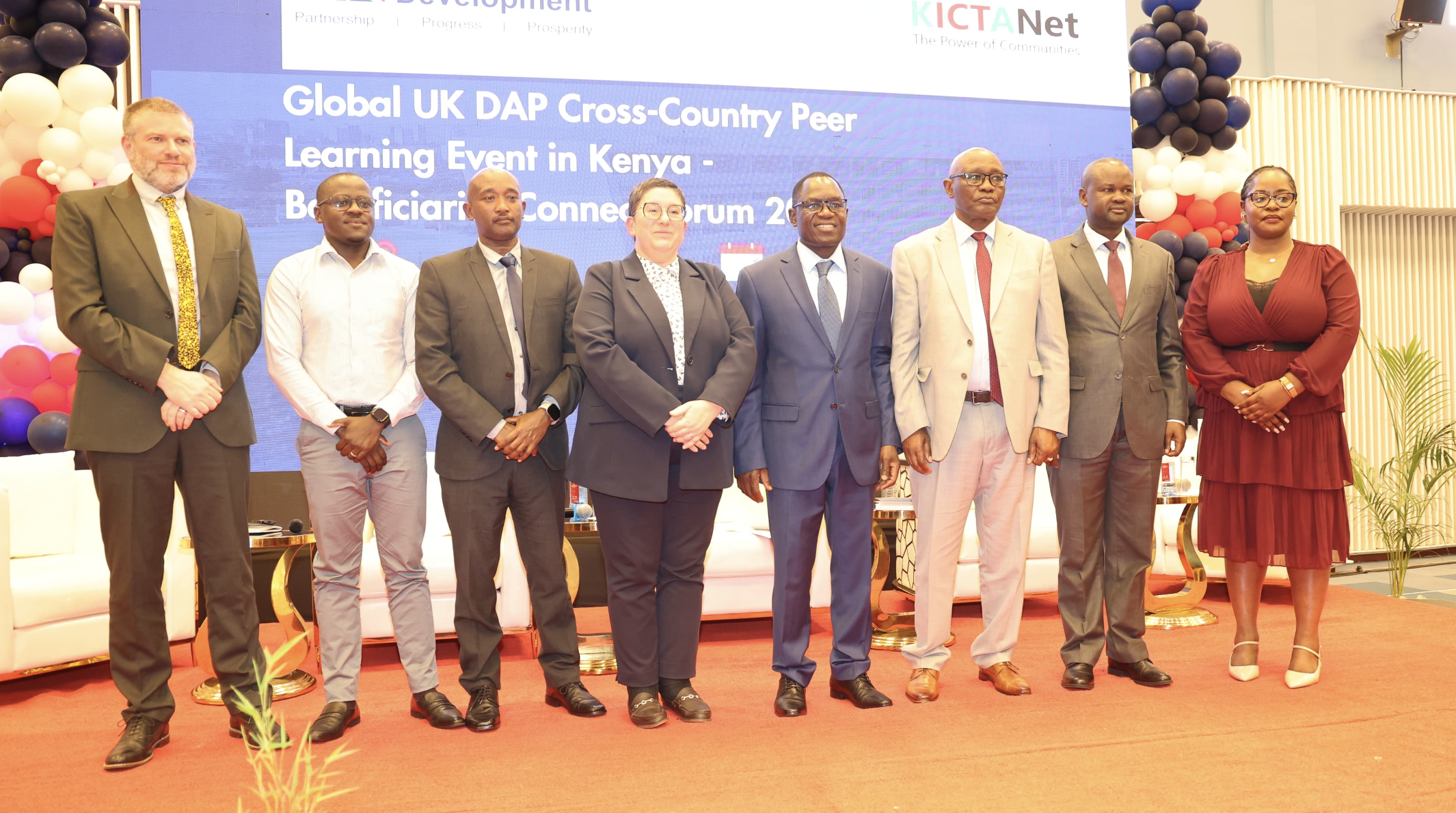
Kenya Pushes for Sustainable Last-Mile Internet Connectivity at Global UK DAP Forum
Kenya has reaffirmed its commitment to achieving universal, affordable and resilient internet access, with government officials calling for stronger partnerships, smart regulation and sustainable financing to bridge the digital divide.
Speaking during the Global UK Digital Access Programme (DAP) Country Peer Learning Event, Principal Secretary for Broadcasting and Telecommunications, Mr. Stephen M. Isaboke, EBS, said last-mile connectivity remains central to Kenya’s economic growth, public service delivery and social inclusion agenda, particularly for unserved and underserved communities.
“Our focus is on delivering sustainable, reliable, affordable and transformative last-mile internet connectivity that drives economic growth and ensures no one is left behind,” he said.
He noted that Kenya’s digital development is guided by a robust policy ecosystem anchored in the Constitution of Kenya (2010), the Bottom-Up Economic Transformation Agenda (BETA), and national ICT strategies. These frameworks aim to guarantee equity, inclusion and access to information while powering data-driven innovation.
Mr. Isaboke highlighted the Digital Master Plan, which targets the rollout of 100,000 kilometres of fibre optic cable, 25,000 public Wi-Fi hotspots in markets, bus terminals and community centres, and the establishment of 1,450 ICT hubs nationwide. These efforts are complemented by the Universal Service Fund (USF), which de-risks private investment and supports connectivity projects in areas deemed commercially unattractive.
He emphasized that sustainable last-mile connectivity must address four interlinked dimensions: financial and commercial viability, technical robustness, institutional capacity and socio-economic impact.
Government, he said, remains responsible for creating an enabling environment through policy certainty, streamlined licensing, fair spectrum management, incentives for rural deployment and public-private partnerships.
Community-centred models, including community networks, cooperatives, small wireless internet providers and ICT hubs in schools, health facilities and libraries, were also cited as critical in enhancing local ownership and resilience.
During the same forum, Hon. James Ongwae, EGH, Chairman of the Universal Service Advisory Council (USAC), lauded the UK Digital Access Programme as a critical partner in shaping Kenya’s universal access agenda. He said UKDAP support was instrumental in the ICT Access Gaps Study 2021, the USF Strategy 2023–2027, and other regulatory and policy interventions.
“While Kenya has made remarkable progress in ICT penetration over the past 25 years, market forces alone cannot reach every community,” he said. “Large parts of our rural, remote and marginalized regions remain commercially unattractive, yet connectivity in these areas can be truly transformational.”
Hon. Ongwae highlighted the tangible impact of USF interventions, including voice infrastructure in remote areas, broadband connectivity for schools and public institutions, nationwide digital hubs, digitized education content and projects enhancing access to justice, such as the Judiciary LAN initiative.
Looking ahead, he said the USF Strategy 2023–2027 envisions the Fund as a catalyst for a competitive and inclusive digital economy by closing remaining connectivity gaps, improving service quality and affordability, expanding digital skills, supporting local content ecosystems and strengthening institutional capacity.
However, he cautioned that the strategy faces significant constraints. With an estimated budget of KSh 40.37 billion, the USF currently faces a funding shortfall of KSh 11.84 billion, alongside capacity limitations and the rising cost of deploying infrastructure in hard-to-reach areas.
“Sustainable last-mile connectivity cannot be achieved through funding alone,” Hon. Ongwae said. “It requires blended financing, co-investment with industry, community involvement, innovative technologies and strong partnerships.”